Your cameras already see.Now they understand.
A guest walks in, the queue grows, a table frees up — your cameras already see it. SERVO turns that into a signal on your manager’s phone: on your own server, with no new hardware.
One location · three days · no cost
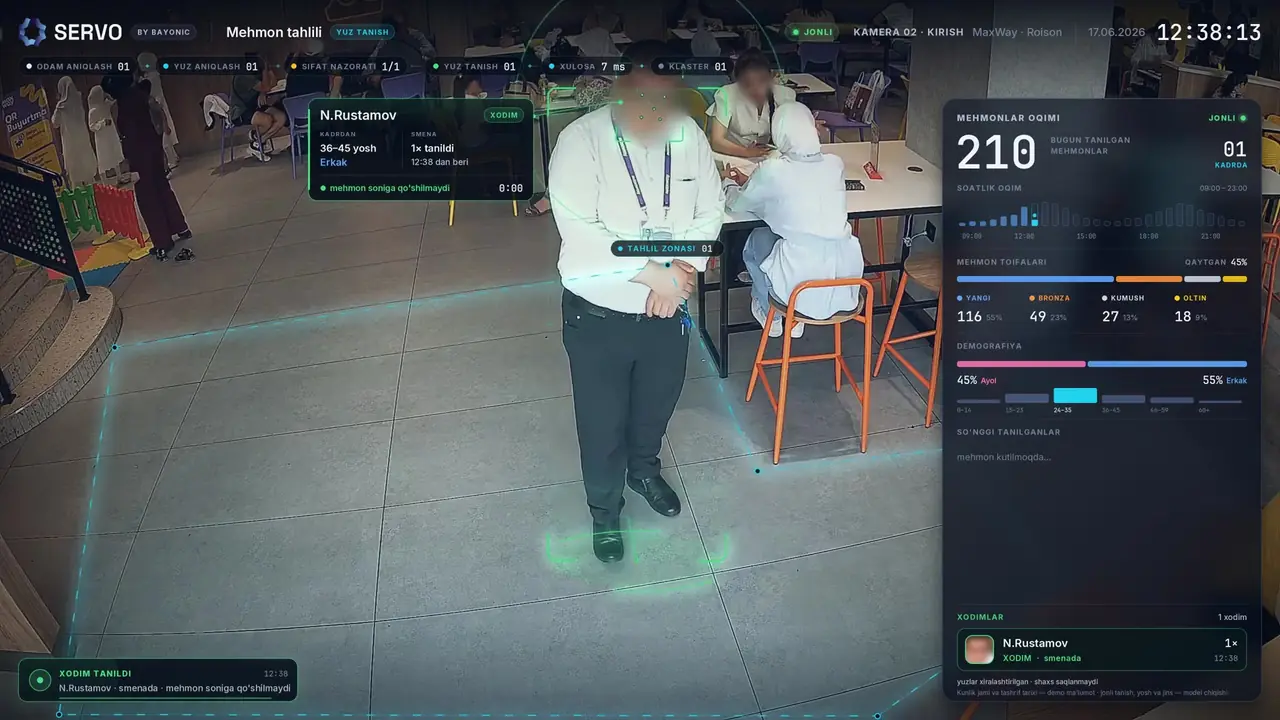
LiveReal recording · MaxWay Roison · entrance cameraNot a mockup: the running system’s own screen
248,000 UZS was recorded.
Everything else was not.
This check is the only record your business kept of that minute. Who the guest was, how long they waited, whether they ever come back — nowhere. An owner’s eight questions are born every day out of exactly these blank lines.
The only record your system kept
questions, and not one of them has a number for an answer today.
“If you cannot see it, it does not exist.”
Eight questions a restaurant owner asks
Your answer todayTap a question — we show why there is no answer
An ordinary working day. The footage speaks for itself.
Recorded at MaxWay locations. The date, time and camera number in the frame are unaltered — pause it, zoom in, check.
Every guest who walks in is recognised and their tier updates instantly.
By the till, the guest’s tier is already on screen.
11 modules — one frame, one server.
Nobody drops out, even at peak.
More than one guest in five is already a regular at another of your locations.
Where is your restaurant losing money?
Eight questions, each answered by the cameras you already have. Pick one: one restaurant, one day, and every number shows its working.
Guests
Who came through the door, and who comes at which hour?
- New30362%1 visits
- Bronze10722%2–4 visits
- Silver4910%5–7 visits
- Gold296%8+ visits
At lunch the main guests are aged 25–34, alone or in pairs. In the evening the 18–24 group grows fastest, and 38% of tables are families. 51% of guests are women.
Run a quick solo menu at lunch and family tables and set menus at dinner. The host sees Gold guests the moment they walk in.
01Guest Recognition02Customer Segments04Daily TrafficWhat this costs in money is below, worked out from your own daily guests and average check.
Work out the costUpload the report — get the answer
The console exports last night as spreadsheets. Type your question — SERVO's analyst reads those files and answers: one figure, the evidence for it, and one next step.
Why did tables sit empty last night?
Tables were not cleared as guests left: for 86 minutes a table stood unsold, and that is exactly when 5 parties walked in.
- 86minutes a table stood idle past the 5-minute line
- 5parties walked in during exactly those minutes
- 4guests found no seat that evening
What caused it, and what was ruled out
Tables stood uncleared for 141 minutes in all last night; 86 of those are past the 5-minute service line. An average seating runs 64 minutes, so that is ~4 guests — about 120 a month at the same rate.
Mechanism. At 20:18 the floor had 3 uncleared tables and 3 free ones. The longest was table 14: 28 minutes. The signal already exists — the console writes “table 09 is free”; the question is whether the message reaches anyone.
- The data rules out
- “The room was full” — it was not: at that minute 3 tables stood empty and 3 uncleared.
- “The waiters could not keep up” — the evening ran 68 seatings, a 3.4× turn; what slowed were 11 clear-downs, the ones where the message was late.
Conclusion. This is not a headcount question but a signal question: the minutes between “table free” and “table clear” are not sold.
How it is measured. 14 days: the median clear-down time — the count of clear-downs over 5 minutes should fall towards zero; the control metric is the number of parties kept waiting.
Eleven modules. One system.
Each module answers one question on the floor. All of them run on one data layer — which is why the system reports not that there was a queue, but why there was one.
- 05Table Occupancy03Customer Traffic08Speed of Service
"At 20:10 three people were queuing — because tables 7, 9 and 12 sat uncleared for nine minutes."
- 01Guest Recognition02Customer Segments10AI Forecast
“Your Gold guest has fallen out of their fourteen-day rhythm — third week without a visit.”
- 11Safety and incidents09Cleanliness & Tables07Staff KPI
"The fryer was unattended for four minutes — two staff went on break at the same time."
Each of the three sentences needs all three of its modules; with two of them it is never produced at all. A queue counter reports that there is a queue. Only a system whose tables, footfall and service clock sit in one data layer reports why.
The module catalogue
11modules · open any cardModelThree numbers. One answer.
Guests a day, the average check, the number of branches — nothing else. Every line shows its arithmetic.
0.50% of daily guests × average check
Over the queue threshold an alert reaches the manager and a table is prepared
03 · Customer TrafficYou pay per month 3.1M UZS · Net 8.8M UZS · 3.8×
- Recovered over the year
- +136.6
- Subscription · 12 mo
- −37.8
- Setup · one-time
- −3.8
- Net, first year
- +95.0 M UZS
If the daily report is not running within 30 days, you get a full refund.
The model’s assumptions — all of them
- Loss shares are SERVO’s industry estimate; during the pilot they are replaced with your location’s measured figures.
- The “SERVO recovers” column is the share of each line that actually closes (20–70%). An alert does not stop every walk-out, and a dead zone needs the floor plan changed.
- Platform cost: $250 per location per month for the standard package, at 12,600 UZS to the dollar. Real pricing is quoted per requirement.
- Month one runs at 55% and month two at 85% while thresholds settle to the kitchen. The break-even figure is computed with that.
- One-time onboarding: camera survey, edge server, POS integration and team training — $300 per location.
- Cautious case: every line recovers half as much. That is the dashed line on the chart.
The face is not stored. Only a number remains.
The system does not need a picture to recognise a guest. A mathematical vector is taken from the frame and the frame itself is destroyed at once — the matching runs on the vector.
Live in three days. Two hours of yours.
Every day in two lines: what that day takes from you, and what you hold by the end of it. On none of the three days does the floor close.
- 3 daysfrom contract to live
- 2 hoursof your time, in total
- 0new cameras — yours are used
- Day 1
Audit and install
- From you
- Access to the cameras
- You have
- A camera-coverage map and the edge server in place
- Day 2
Tuning and integration
- From you
- Nothing
- You have
- The system in sync with POS / 1C, SOP thresholds set to your kitchen
- Day 3
Training and go-live
- From you
- Two hours
- You have
- That same evening — the first daily report. From then on, 24/7 monitoring.
- 24/7 monitoring — we watch the system
- A daily report every evening
- No report within 30 days — full refund
Which location do we start with?
The busiest one — that is where the numbers show up fastest. In a month you put the second one beside it.
- First call — 15 minutes
- From you: a camera list and two numbers
- No sales pressure
- One training session for the team, no extra work for you